 How do you cap off a month filled with monsters, suspense, and murder? With a sweet, happy ending of course! Sadly, nothing in life can be that easy, especially with the mysterious concoction I’ve got my heart set on: the soufflé.
They rise and fall at will, seeming to defy gravity.
I tried to making one on my own, realizing only after the fact (and lots of Internet research), that it wasn’t a traditional soufflé at all, but more of a chocolate lava cake. So I enlisted the help of Chef Warren Brown, founder and owner of the legendary D.C. bakery, CakeLove, entrepreneur, baker, cookbook author and mad cake scientist. I was hoping he could help us make something more authentic … but that’s not what he had in mind at all.
The issue with soufflés, Warren says, is that the proteins in the batter stretch up, rising as it bakes. Once you remove it from the oven, it falls, and your beautiful creation collapses in on itself. This causes the texture to change, and that means the best bite of a soufflé is always the first, right out of the oven (also, tongue-burning hot!). But once you cut it, the air you whipped into it so carefully deflates like an old tire. What was once light and airy soon becomes tight and rubbery.
It doesn’t make sense for a cake shop to bake a soufflé. It’s an on demand dessert.
But Warren has a secret up his sleeve to slay this beast — Italian meringue. Consider it like Fix-A-Flat for your soufflé. No surprise, then, that meringue just happens to be the secret ingredient in his delicious Amaretto Soufflé Cake, the recipe he’s sharing with us.
And why is he sharing it, you may ask?
“You can put it on the web site,” he says. “Nobody’s going to make it — it’s too complicated.” (Which is funny, because he makes it look so easy.)
The meringue was a discovery born in his early baking days, before he opened CakeLove and while he was still honing his baking skills. Like most home cooks, Warren had one mixer and one bowl at the time. When a recipe called for whipped egg whites, he would whip them first and then transfer the mixture to a new bowl, where the whites sat while he prepped other ingredients in the mixer. Inevitably, the whites would separate and de-puff.
But after making an Italian meringue one day, something clicked.
By pre-cooking the egg whites with sugar and a touch of water, none of that puff and consistency are lost, because the tempering stabilizes the egg whites.
Wait … tempering?
Tempering isn’t commonly used in recipes. Normally, the process is reserved for chocolate or increasing the toughness of glass. Turns out it works on egg whites too.
“Slowly introduce heat, same concept with chocolate,” Warren says, demonstrating this magic — er, science — while moving to the stove to collect a pot. There, sugar and water have been heating up in a pan with a thermometer resting inside.
“Not enough home cooks know what a thermometer is,” says Warren. He recommends the Taylor candy thermometer. Not only does it have easy to read numbers, he says, but also notes candy-making temperatures from “thread” to “hard crack”.
The right-sized pan is also key. Too heavy, and the slow pour becomes taxing on your arm and shoulder. Something too large means the liquid will be too shallow, making it harder to gauge the correct temperature. Warren used a one-quart saucepan.
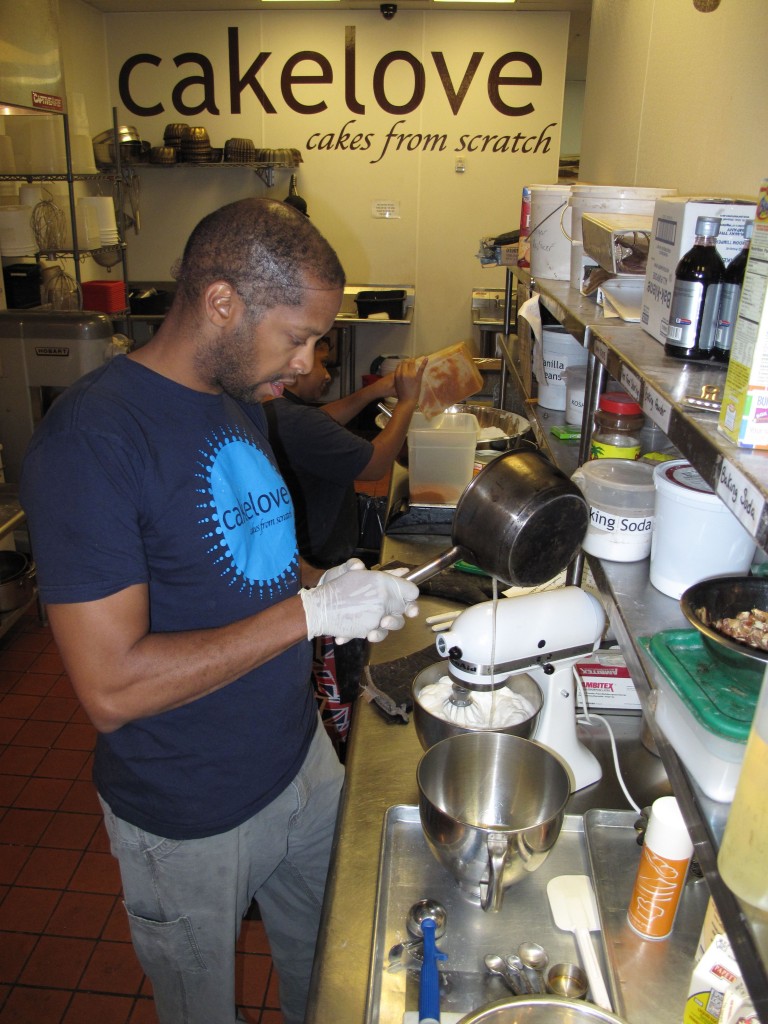
Once the sugar water hits the right temperature, 230 degrees, Warren demonstrates tempering by slowly pouring it into the egg whites. While the stand mixer beats away, he pours the liquid in a slow, steady stream aimed at a spot between the whip attachment and the bowl. He points out his technique for pouring: Rather than turning the wrist, raise the shoulder.
“Eye in the bowl,” Warren urges. Pouring too quickly causes the hot sugar water to ball and knot at the base of the mixture. Slow and steady wins the race.
Sure enough, light, fluffy meringue begins to puff up in the bowl. The chef whips until it is fully dispersed, about a minute or two. He removes the bowl from the mixer and sets it aside.
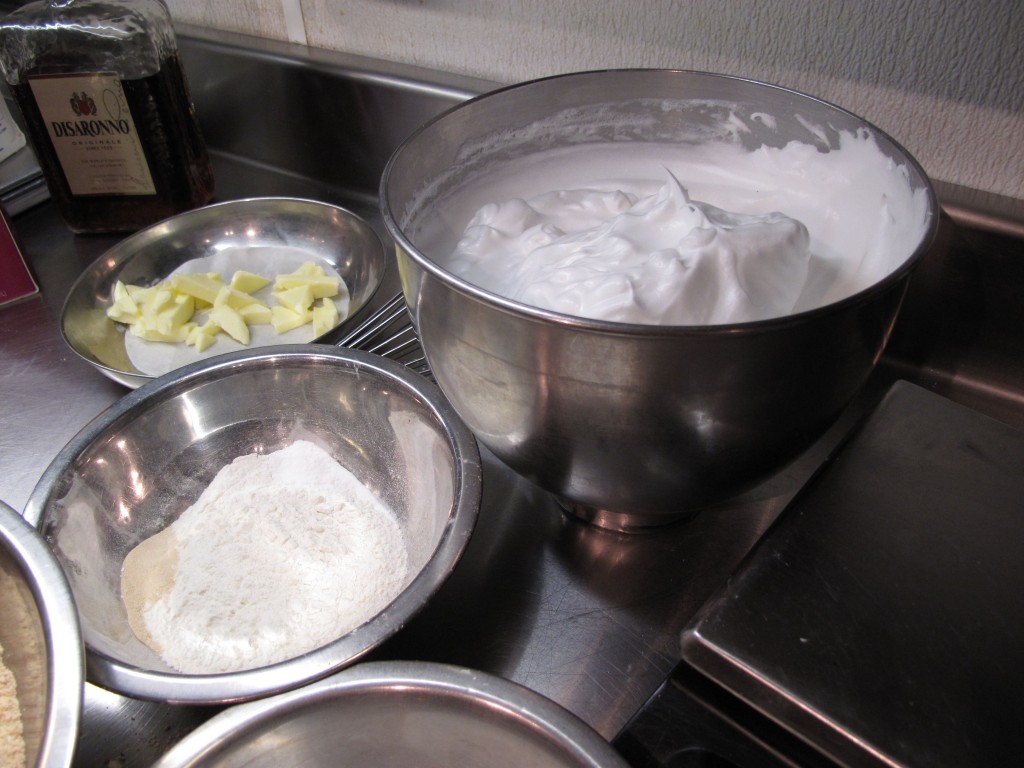
After mixing up the rest of the batter in a separate large bowl attached to the stand mixer, he turns back to the meringue, which has stayed fluffy and puffy. No falling! He adds half the puffy mix to the cake batter while the mixer is still running. He leaves the rest in the bowl attached to the stand mixer, but removes the paddle attachment in order to fold it in manually. He doesn’t work fast, but uses pressure along the sides of the bowl to incorporate the blobs of egg whites.
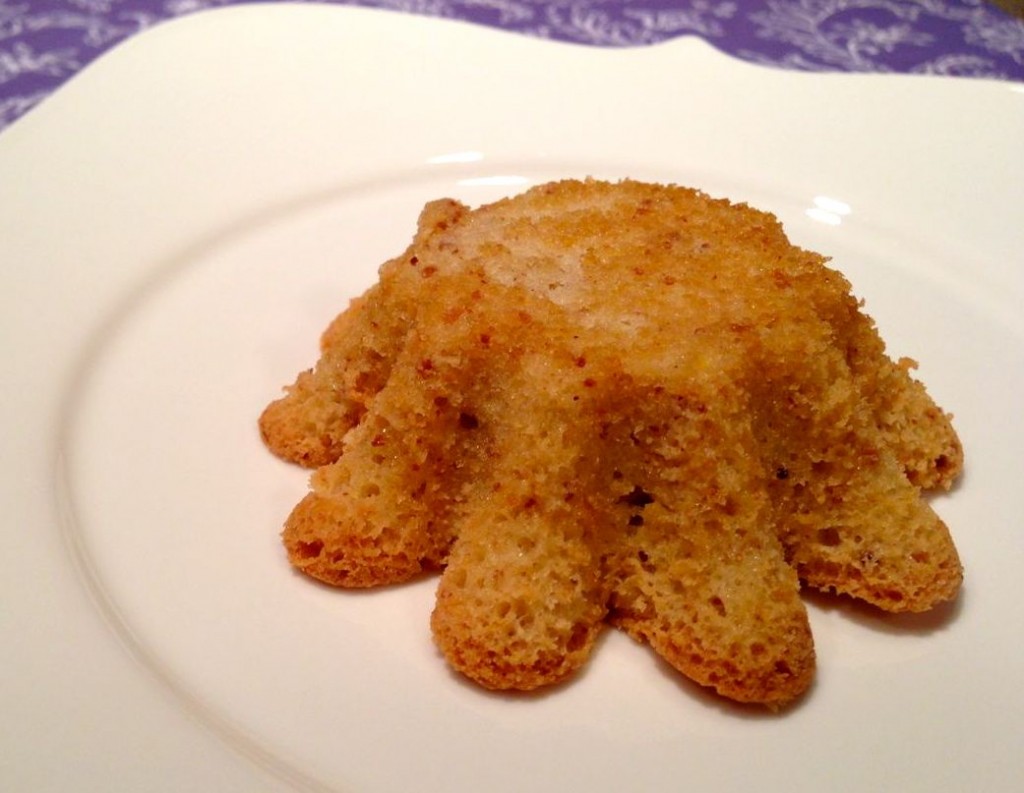
After adding the finished batter to mini brioche pans and baking for about 15 minutes, we’re ready to see the results. I wasn’t expecting a dramatic soufflé puff — which is definitely not there — but I’m not sure I was expecting this thing he calls “crunchy feet,” either. After checking the done-ness of the cakes with a long cake tester, he pops them out of the molds and we taste test. Indeed, they are light. This cake is truly gravity-defying, and with the use of the Italian meringue, it actually stays that way.
Warren uses this technique in several of his signature cakes, like pistachio, peanut, white chocolate, and Neil’s Hat Trick. But it is this cake that he considers his big epiphany — his Newton’s apple. In the end, I discovered that just as lobster can be bisque and artichokes can be stuffed, even the terror of the soufflé can be tempered, with meringue.
Amaretto Souffle Cake
Chef Warren Brown has written several cookbooks, including CakeLove: How to Bake Cakes from Scratch and CakeLove in the Morning. Many thanks to him for inviting We The Eaters into his kitchen, and for sharing the recipe below with our readers.
Note: The recipe calls for weighted measurements (using a kitchen scale) rather than volume — a mainstay for professional bakers, as different flours have different weights, and many volume measures can vary slightly with humidity and other factors. For a comprehensive conversion chart, check out The Baking Pan.
9 ounces egg whites
10 ounces sugar
1/4 cup water
4 egg yolks
2 ounces sugar
1/4 cup heavy cream
1/4 cup amaretto
2 1/2 ounces butter, really soft
10 ounces almond powder
4 ounces rice flour
4 ounces all-purpose flour
1/4 teaspoons baking powder
pinch salt
1/2 teaspoons vanilla powder
To make the meringue:
Create the sugar syrup by adding the sugar and water to a 1-quart pan. Bring to 230 degrees, using a candy thermometer. Whip the egg whites and slowly pour in the sugar syrup until the mixture is stiff with white fluffy peaks. Set aside.
To make the cake batter:
Whip the egg yolks and sugar until the mixture is light in color and has a ribbon-like texture. Still mixing, add the cream and amaretto, then the butter. In a separate bowl, combine the dry ingredients, mixing with a whisk. Add to the egg mixture and continue to mix until combined.
Add about 1/2 of the meringue to the mixer and mix. Then stop the mixer and fold in the rest of the meringue by hand, breaking up the egg whites into the batter.
Add to two 9-inch cake pans. Bake 30 minutes, checking after 22 minutes for done-ness. You can also use the mini brioche tins, which should be well-sprayed with cooking spray. You’ll need to adjust the cooking time accordingly — about 8 to ten minutes, depending on the size of the tins.
Molten Lava Cake
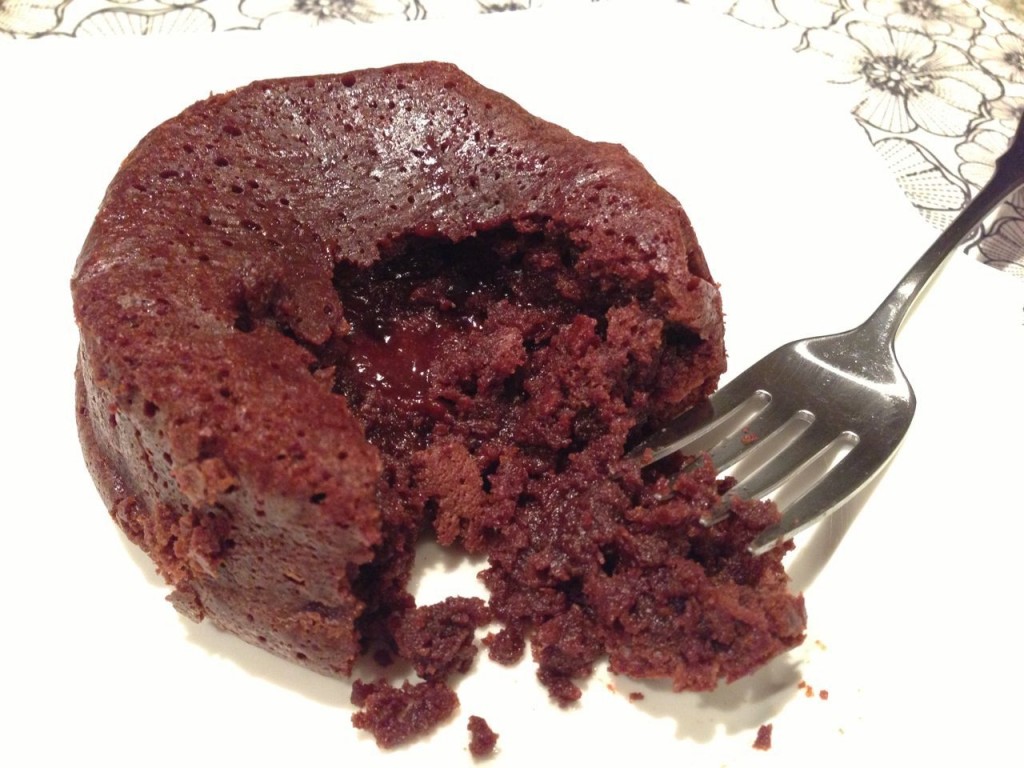 This was the chocolate soufflé I attempted on my own — which turned out to be more of a lava cake. I found it on The Girl Who Ate Everthing blog. While it’s not a traditional soufflé, it did puff up and was quite good. Note the recipe calls for refrigerating the batter overnight. I also kept leftover battter in the fridge and made little ones on demand.
8 ounces chocolate (I used Ghirardelli 60 percent cacao)
12 tablespoons butter
1 cup granulated sugar
3 tablespoons cornstarch
4 whole eggs plus 4 egg yolks
To make the soufflé batter, combine sugar and cornstarch in a mixing bowl. In a separate bowl, whisk together eggs and yolks. Bring butter to a simmer in a saucepan. Add chocolate and mix until smooth. Continue to mix until chocolate begins to simmer along the edges.
Incorporate the chocolate mixture into the dry ingredients until combined. Add eggs and mix at low speed until mixture is smooth and sugar dissolved. Pour into a bowl and refrigerate overnight.
Preheat the oven to 400 degrees. Prep the ramekins or souffle rings by lining with parchment paper or spraying with cooking spray to make it easier to pop out later. I used smaller ramekins, about 3 inches wide by 2 inches tall. Place the ramekins or rings on a baking sheet.
Fill each ramekin with soufflé batter three-quarters of the way full. Bake on top oven rack for about 21-23 minutes, basically until the tops are set but the middle is still gooey. Remove from oven and serve immediately. Left over batter can be refrigerated for up to 10 days.

 So … what did We The Eaters love about the show (aside from all the eating we got to do)? Sarah and Amy (pictured right) both thought the chef presentations were fabulous. Tom Colicchio’s rabbit dish is perfect for something we’ll be dishing out later this month. His teammate Gail Simmons whipped up a basil cocktail that we will definitely talk more about in December. But the show-stealer for us was not only seeing some of these celebrity chefs perform their magic in the kitchen, but getting to talk to them in person.