Back To The Beginning For Sweet Potatoes And ‘The Pine’

With the election madness behind us, WTE’s little presidential culinary tour is coming to a close — but not before a final stop with the nation’s first president, George Washington.
One problem: There’s scant information about Washington’s actual food favorites. I thought I’d hit the jackpot when I discovered Martha Washington’s Booke of Cookery and Sweetmeats. Surely it would be filled with dishes that regularly graced the president’s table?

Not so much, as it turns out. The book was not a compilation of Martha’s personal recipes. Rather, it was a collection of Custis family recipes dating from the 16th and early 17th centuries and passed down to Martha upon her marriage to her first husband, Daniel Custis, in 1749. Food historian Karen Hess, who transcribed the book in 1981, felt it possible that Martha never actually used the family heirloom. While it might have been interesting to attempt “boyled carp in its blood,” it’s probably for the best that I kept looking for a better dish to share.

Historical documents offer some references to meals the Washington family actually ate — like the extravagant spread described by a visitor in 1799, featuring several kinds of meats, cabbage, potatoes, pickles, tripe and onions, followed by pies, cheese, fruit and nuts (and, naturally, wine, beer, port and madeira).  But whether or not any of these dishes qualified as “favorites” is difficult to say. The memoirs of George Washington Parke Custis, Martha Washington’s grandson, indicate the Founding Father was partial to fish. Others have noted that his taste in food was rather plain.

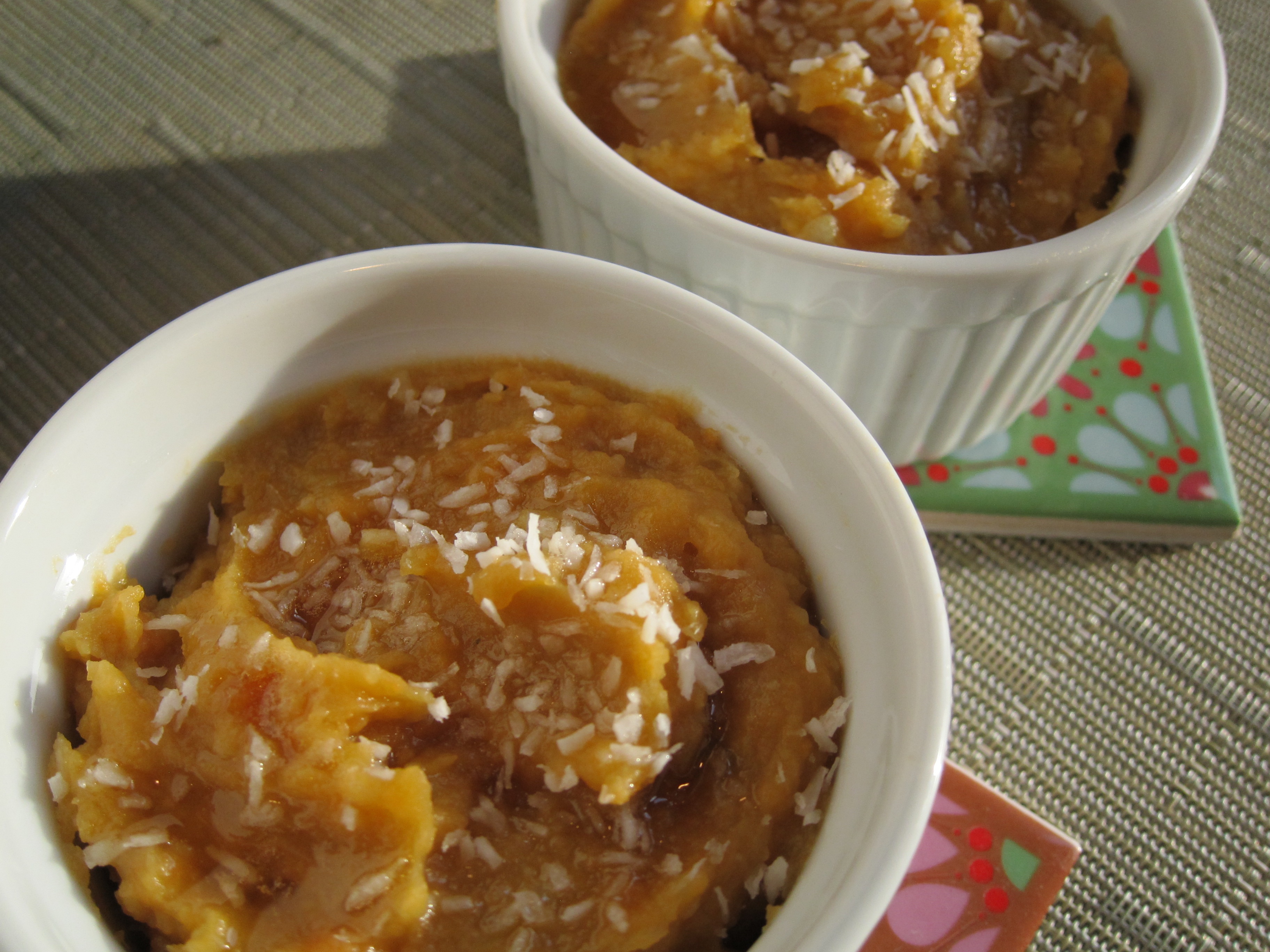
That said, there are some references on the Internet that sound intriguing, even if there’s not a great deal of evidence to back them up. George Washington’s fondness for mashed sweet potatoes with coconut pops up several times, but I’ve been hard-pressed to find any historical documentation of that. But hey — authenticity be damned! Sweet potatoes and coconut are both delicious, so I decided to give it a try. Good thing, too. If this was indeed a Washington favorite, he was onto something.

I give a bit more credence to the information provided by the team at Mount Vernon, Washington’s stately home on the Potomac River. Research historian Mary Thompson says ice cream — served regularly — was likely a “favored dessert.” Also available at Mount Vernon site are excerpts of writing  from Washington’s step-grand daughter, Nelly Custis Lewis, who described hoecakes (essentially, corn pancakes) swimming in “butter and honey” as General Washington’s typical breakfast.

All well and good, but I still wanted to serve up something a bit more interesting for you Eaters. Luckily, Washington was also partial to pineapples. After being introduced to the spiny fruits on a visit to his brother in Barbados, Washington wrote, “none pleases my taste as do’s the Pine.”

With this in mind, I took some inspiration from another reference to Nelly Custis Lewis, as described by the folks at Mount Vernon:

“Her ‘Pine Apple Cream,’ called for steeping or ‘infusing’ a pineapple rind in boiling cream. Utilizing the rind instead of the acidic fruit itself imparted the flavor of pineapple, without taking the risk of curdling the cream.”

English custard-and-cream desserts known as “fools” were popular at the time, so I decided to give Nelly’s technique a try. I tweaked an adapted period recipe for orange fool (the original recipe appeared in a cookbook owned by Martha Washington, Hannah Glasse’s 1747 book The Art of Cookery Made Plain and Easy). I diligently scrubbed my pineapple, cut the rinds from the fruit, heated up my cream and set to steeping. 

Then things went terribly wrong. Perhaps there’s good reason this technique has faded into obscurity,  because this cream was absolutely horrid. It was bitter. It tasted spoiled. And it went straight down the drain.
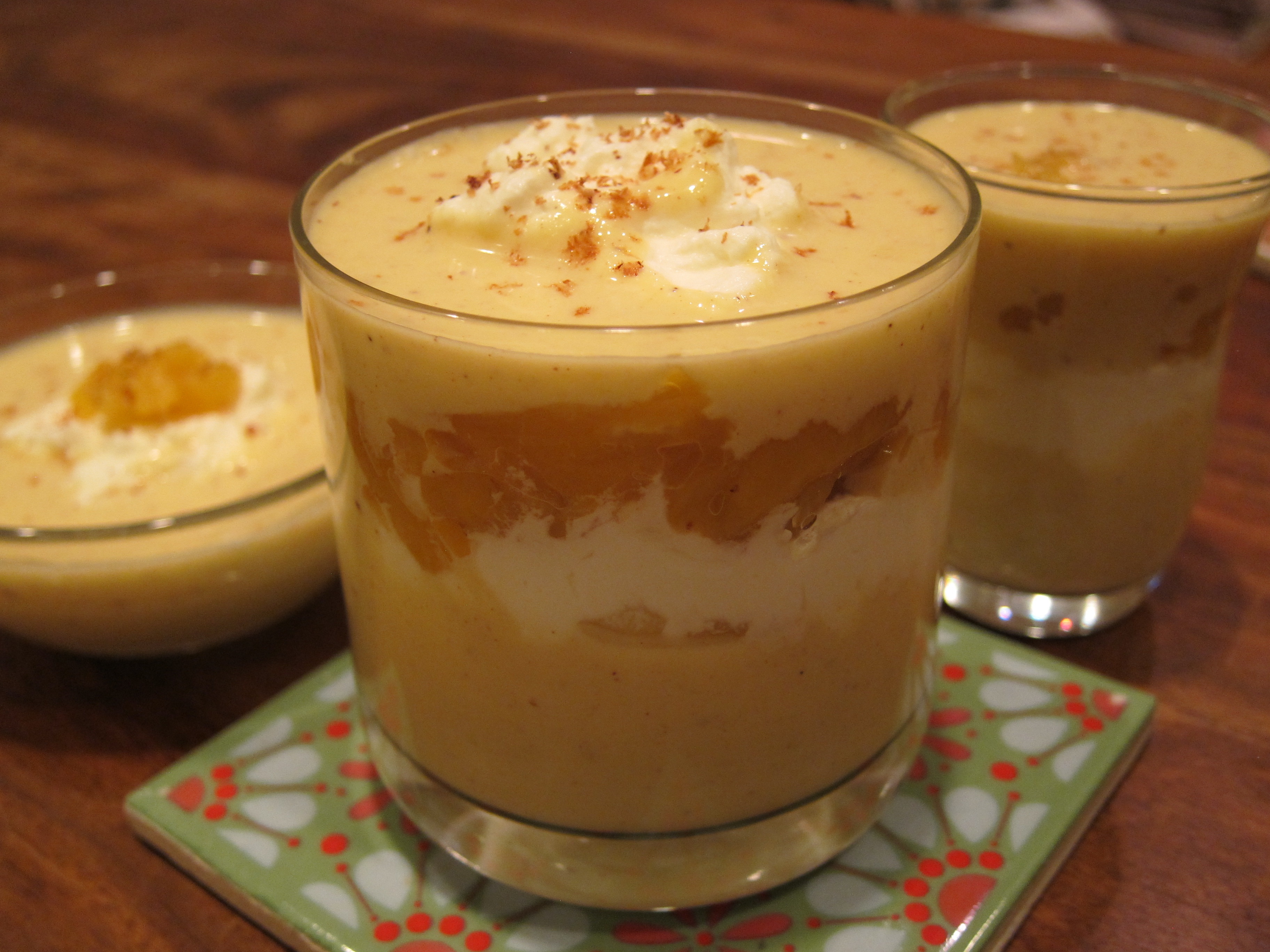
So much for history-inspired experiments. I went back to the fool recipe, this time swapping actual pineapple for the oranges, and subbing pineapple juice for the orange juice.

Would I recommend making this? Yes and no. Here’s the thing: It’s absolutely delicious (Amy licked her bowl — true story). But the custard simply wouldn’t set. I simmered and stirred for an hour, and while it did thicken slightly, it never reached the right consistency. I think the culprit may be the whole eggs. Many custard recipes recommend using egg yolks without the whites. Because this recipe truly is worth making, I recommend trying it using four yolks, rather than four whole eggs (full disclosure — I haven’t tried that revision myself, but I will!). 

And that’s it! I’m no president, but (with a little tweaking), I’ve hit upon a few new personal favorites on this little historical tour. Enjoy!

Mashed Sweet Potatoes With Coconut
Adapted from Family Fresh Cooking

2 pounds sweet potatoes (I used a mix of the standard and Japanese varieties)
¼ cup coconut milk
¼ cup unsweetened grated coconut (you could use the grated sweetened type, but the result will be cloyingly sweet. If that’s how you like your sweet potatoes, go for it!)
1 ½ to 2 tablespoons brown butter (I used this technique)
¼ teaspoon nutmeg
salt and pepper to taste
Maple syrup for drizzling
Grated coconut for sprinkling

Scrub the potatoes and chop into chunks about three inches thick. Toss them into a big pot of boiling water, and boil until they’re soft enough to spear with a fork.

Drain and cool the potatoes until you can handle them. You can slide off the peels now, if you like, or leave them on.

Mash the potatoes and all ingredients but the maple syrup with a potato masher or ricer.

Spoon into your serving dish or individual serving dishes, drizzle with maple syrup, and sprinkle with a bit of grated coconut.


Pineapple Fool
Adapted from Hannah Glasse, via Damon Lee Fowler 

4 large eggs (I recommend using just the yolks)
1 1/4 cup pineapple juice (1/4 cup reserved)
3/4 cup sugar
1/4 teaspoon ground cinnamon
1/8 teaspoon ground nutmeg
2 cups heavy cream (1/4 cup reserved)
1/3 cup finely chopped pineapple
Dash freshly ground nutmeg, for garnish

Beat the eggs with a mixer until they’re a pale yellow. Mix in 1 cup pineapple juice, then the sugar and spices, until all are well-blended.

In a medium sauce pan over medium-low, bring 1 3/4 cups cream to just below boiling, stirring often (you don’t want the bottom to burn).

Whisking constantly, pour 1/2 cup of the hot cream, extremely slowly, into the egg mixture (you want to prevent the hot cream from cooking the eggs). Once it’s well-blended, pour the entire egg mixture into the pan with the rest of the hot cream , still whisking. On low and stirring constantly, cook until it all thickens enough to coat the spoon.

Note: Don’t let the mixture boil — it will cook the egg. You’ll know that’s happening if it seems to start curdling. If you see the slightest hint of a curdle, you can still save the custard: pour the entire mixture out of the hot pan, add a small splash of cold cream, and whisk, whisk, whisk until smooth before pouring back into the saucepan and returning to the heat. Cook over low heat, stirring constantly until it thickens enough to coat back of spoon.

Remove the thickened custard from the heat, pour into a bowl and refrigerate for at least two hours (you can put a layer of plastic wrap on the top to prevent a skin from forming).

To prepare the pineapple, stir the chopped fruit with remaining 1/4 cup pineapple juice in a small saucepan. Cook, stirring occasionally, until the juice has evaporated and the fruit is slightly cooked; about five minutes.

To serve, whip the remaining 1/4 cup cream. Layer the custard, whipped cream and pineapple in serving glasses, and top with a dollop of whipped cream topped with a tiny dash of nutmeg.

Makes about 6 to 8 servings

Tagged with: , , , , , , , , , , , , ,
Posted in Dear Diary

Thomas Jefferson, America’s Founding Foodie

I’m going to have to make a conscious effort not to write too much in this post. The problem is, there’s so much to say about the man who was:
  • an American Founding Father,
  • the main author of the Declaration of Independence,
  • the first secretary of state (a post he discovered he held after reading about it in the paper),
  • third president of the United States,
  • the man who orchestrated the Louisiana Purchase,
  • the founder of the University of Virginia.

And that’s the short list. A lawyer by his mid-twenties, Jefferson was also a philosopher, an author, a botanist and architect. He was fluent in five languages and read in seven — refusing to read books in anything other than the language in which they were originally penned. Perhaps President John F. Kennedy described it best when, addressing 49 Nobel laureates dining at the White House in 1962, he said “I think this is the most extraordinary collection of talent, of human knowledge, that has ever been gathered at the White House, with the possible exception of when Thomas Jefferson dined alone.”

But Jefferson rarely dined alone. Elizabeth Chew, curator of collections at Thomas Jefferson’s Monticello, says there were always people coming to dinner, especially at the President’s House (which today we’d call the White House). There, Jefferson entertained everyone from legislators and diplomats to explorers and Indian chiefs. Chew says the table was an extension of his office, and the president used it as another venue where he could get political work done.

Jefferson The Gardner

From his personal correspondence, notes and documents, historians paint a picture of a man filled with curiosity about growing, preserving and cooking food. In his day, Jefferson was criticized for eschewing the foods of his homeland for cuisine discovered while serving, at George Washington’s behest, as the United States minister to France. A ridiculous critique, considering he had Virginian hams — which he described as “better than any had on this side [of] the Atlantic” — shipped to him while living there. Jefferson also requested seeds for corn, cantaloupe and sweet potatoes while living in Paris.
What is true is that Jefferson’s time  abroad opened new culinary doors, as he discovered new favorites like Marseille figs (the food, not the band) and French tarragon.

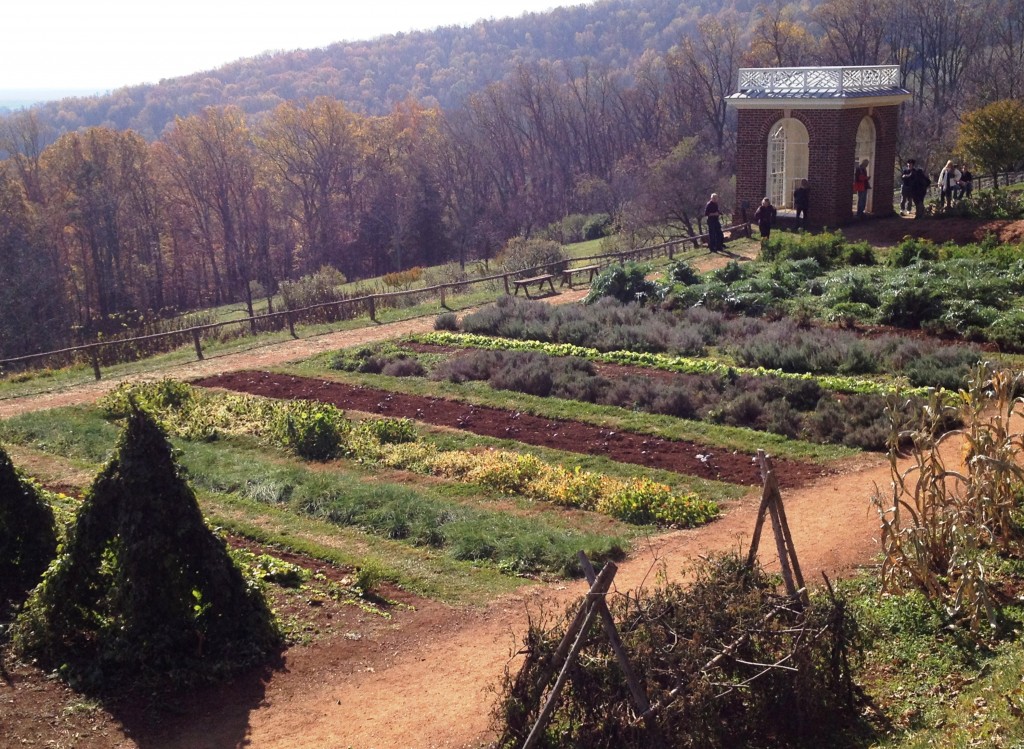
On the grounds of Monticello, built on the property Jefferson inherited from his father, visitors will find a garden the length of three football fields. Vegetables are clearly the winner here, with neat rows of peas, tomatoes, benne, used to make sesame oil for salads, and multiple lettuce varieties. And that’s just the tip of the iceberg (pun intended). Jefferson’s records document more than 300 different varieties of vegetables once grown here. From hyacinth beans (mostly ornamental) to sea kale — things not typically found on American soil — the gardens of Monticello are as much a feast for the eyes as for the belly.

Jefferson visited the gardens almost daily, taking a halfhour stroll to see how his plants were progressing. Despite the bounty from his own crops, Jefferson’s family also bought vegetables — potatoes, hominy beans and cucumbers — from slaves living on the plantation.

Jefferson The Slave Holder

Jefferson had many slaves — more than 100 at any given time. James Hemings, the half-brother to Jefferson’s wife, Martha, is perhaps the most famous among them. At 19, the young slave accompanied Jefferson to Paris, where Jefferson had him trained in the ways of French cooking. After serving his master in the kitchen for about a decade, Hemings asked Jefferson for his freedom. An agreement was executed between the two, allowing that Hemings would go free after he sufficiently trained a replacement. Once the agreement was satisfied and Hemings freed, he made his living working as a cook. A living, perhaps, but not a life. He returned to Jefferson’s service for a short time in 1801 for $20 a month in wages. A little more than a month after that period of service ended, Jefferson received word that Hemings had taken his own life.

Jefferson The Foodie

With all that grew around him, it’s no surprise Jefferson was a veggie lover. “I have lived temperately,” he once said, “eating little animal food, and that … as a condiment for the vegetables, which constitute my principal diet.”

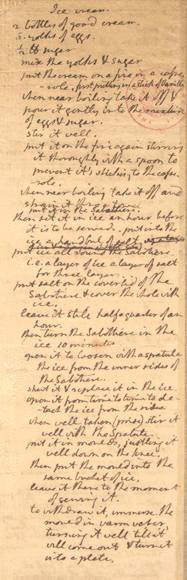
While Jefferson introduced or popularized many produce items in the U.S., he also championed several non-horticultural foods, like  macaroni with cheese sauce — the granddaddy of mac n’ cheese — and ice cream. In fact, the first known American ice cream recipe is penned in Jefferson’s own hand. Good food was as much his signature as the script appearing on the document that claimed our independence.

As much as Jefferson enjoyed eating, it’s also something for which he paid dearly. The founding foodie spent a small fortune putting food on the table for himself, his family and the legions of guests he entertained. According to Monticello’s Elizabeth Chew, they were literally eating him out of house and home. The resulting mountain of debt explains, in part, why Monticello and Jefferson’s belongings — including his enslaved workers — were put on the auction block after his death.

Jefferson: A WTE Tribute

Historians give Thomas Jefferson credit for introducing yet another delicacy to the American palate: French fries. Dining notes from the President’s house indicate potatoes were cut into small slices and deep fried.

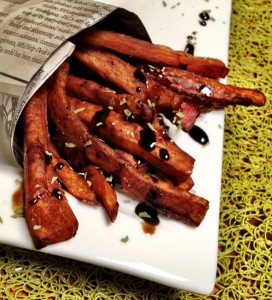
For this week’s post, I’ve opted for a twist on this modern-day favorite, incorporating some tricks learned at the vinegarmaking workshop I took before touring Jefferson’s much-loved home (you’ll learn more about that on Monday, with our next “Meet The Chef” post). For a beach fanatic like me, there’s nothing quite like boardwalk fries with salt and vinegar. But you, dear Eaters, are an upscale audience, and that classic preparation just seemed too simple. So instead, enjoy my take on what I think would quickly become a staple in Thomas Jefferson’s home: sweet potato fries with a maple balsamic reduction.

There’s no recipe for this iconic dish among Jefferson’s documents. That pretty much goes for all vegetables, which is strange, considering his affinity for them. It is widely believed that many of these simple dishes featuring the garden’s bounty didn’t require one (unlike those with precise measurements, like this recipe for Biscuit de Savoy, also written by Jefferson.)
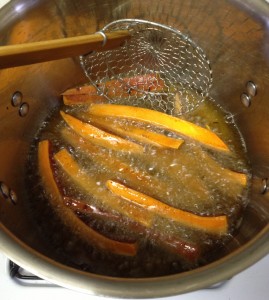
So I drew inspiration from Damon Lee Fowler’s book, Dining at Monticello. When specific recipes were missing, Fowler’s book turns to The Virginia Housewife by Mary Randolph, first published in 1824. We’re going for authenticity here, which means cooking the potatoes in lard, which I don’t have. And bacon drippings. Only, I don’t have that, either.

Thankfully, there’s a great charcuterie near me: Three Little Pigs. When I stop in to pick up the lard, owner Carolina Gomez suggests using the fat rendered from a bacon end to impart the flavor she imagines is what’s behind using the drippings in the first place. As you can see from below, I added this to the lard. As for the rest … I’m making it up as I go along. Let me know what you think — and stay tuned for Monday’s “Meet The Chef” post featuring Charlottesville winemaker Gabrielle Rausse.

All of the information in the article was gleaned through three sources: my interview with Elizabeth Chew, in features found in Damon Lee Fowler’s book, Dining at Monticello, and on Monticello’s website.

As thanks to Chew and the Monticello staff for their time and generous assistance, WTE has offered Monticello space to advertise their tours. The space is offered free of charge, and has not influenced the material in this week’s post or the upcoming “Meet The Chef” post. That said, the Monticello tour is a fabulous experience, and I highly recommend it for all foodies.

Sweet Potato Fries with a Maple-Balsamic Reduction

Two large sweet potatoes
Lard (amount varies based on what you are cooking in, see instructions)
Bacon drippings (or bacon end)
Salt and pepper, coarsely ground
1 teaspoon fresh or dried tarragon

Scrub the potatoes, but leave skins intact. Using a mandolin if possible — or even better, a French fry cutter (lucky you), cut the potatoes into quarter-inch wide strips (mine were a bit thicker, and though delicious, they didn’t get nice and crispy). Barring those tools, the same can be accomplished using a knife with a healthy dose of patience.

Place potatoes in a large pot and cover with water, letting them soak for at least one hour and up to eight. This helps remove some of the starches. If you don’t have bacon drippings, cut up the bacon end, or even thick-cut pieces of bacon, into a heavy-bottomed pot (I used a stock pot to avoid grease splatters) and heat until fat is rendered out. One fat bacon end produced about a 1/2 cup of drippings for me. Remove pieces of meat left from bacon end from the fat and add about two cups of lard. I fried in small batches, which required less of both the bacon end and the lard (if you have a deep fryer, you’ll need to adjust how much you buy accordingly.)

Heat the lard to 325 degrees, using a thermometer to check the temperature. To do this, you need to carefully tilt the pan, because letting the thermometer rest on the bottom will skew your results. Once you’ve reached the right temperature, begin cooking the potatoes in batches for about 3 to 5 minutes until the skin begins to bubble and fries are tender.  Using a skimmer like the one pictured, remove and let fat drain off before putting the fries on a large baking tray. Do not use paper towels as oil-wicking will leave fries soggy.

Let the oil come back up to temperature between batches. Once all potatoes have made it through once, this is a good time to break and make your reduction (see recipe below).

To give the potatoes their second fry, increase the temperature of the oil up to 350 degrees and repeat the process, cooking for up to two minutes, until the fries begin to turn golden brown. Remove, drain and place on a large serving plate. Salt and pepper to taste. Drizzle with reduction and sprinkle fresh or dried tarragon on top and serve. You could also substitute baked sweet potato fries to lighten this up a bit.

This balsamic reduction has so many uses — to dress mashed sweet potatoes, as a salad dressing or even as a topping with fresh strawberries on vanilla ice cream.

For the reduction
1/2 cup balsamic vinegar
2 tablespoons pure maple sugar

In a small sauce pot, begin cooking balsamic and syrup on medium-high heat, stirring almost constantly. Be careful not to inhale over the pot (cough, cough.) The mixture may bubble up — if it does, turn the heat down.

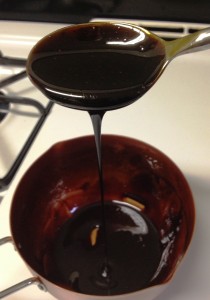
Cook for about 10 minutes until it thickens just slightly (it will continue to thicken as it cools down). You don’t want it watery, but you don’t want it too thick, either. When you raise some in a spoon, it should fall from the middle underneath the spoon in a steady stream. If it splatters, it isn’t ready, and if it falls from the edge of the spoon and is thick like chocolate syrup (as pictured with my first batch), you’ve gone too far. This takes a little practice — believe me — but is well worth it!

Yields four to six generous servings

Tagged with: , , , , , , , , , , , , , ,
Posted in Dear Diary

Game For A Little Rabbit? Teddy Always Was

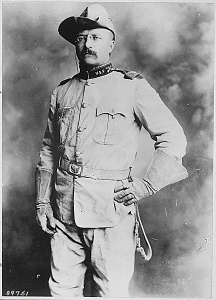
I have a bit of a crush going on for the 26th President, Theodore Roosevelt. Something about the moustache, the rough and tumble charisma.
Teddy was an environmentalist and an adventurer. He boxed regularly, went on African safaris and led the Ruff Ryders … er, make that Rough Riders. He was shot in the chest and still gave a 90-minute campaign speech. Now that’s a man.

Roosevelt was the original Ron Swanson. He loved meat and coffee. He ate the game from his frequent hunting expeditions, and drank about a gallon of coffee a day. Incidentally  he also took nitroglycerin pills for a heart condition (go figure). 

OK, just thinking about him brings a rosy blush to my cheeks. I feel like I’m writing in my personal diary!

Focus, Sarah, focus.

I wanted to honor Teddy by cooking a game meat, but it was difficult to narrow down exactly which one to tackle. Of course, this becomes easier when you realize your local big box grocery doesn’t carry game. No elk, antelope, venison, rabbit, quail … nothing. And I wasn’t going to gear up and “shoot me a beast.” I may admire Teddy’s hunting prowess, but for me personally, well, that would be tragic.

Luckily, inspiration hit in the form of Top Chef judge Tom Colicchio. We The Eaters recently attended the D.C. Metro Cooking Show, where Tom demonstrated preparing rabbit. And, it just so happens that Tom’s dream dinner guest is none other than my favorite historical hottie — Teddy.

According to Tom, rabbit is quite a healthy meat; light and not too fatty. He likes to serve it in many of his restaurants because of its versatility, that he says lends itself well to summer or fall flavors. He described a summer dish he created, for example, in which he paired rabbit with pickled watermelon. For this demonstration, Tom paired his rabbit with figs, basil, and pistachios.

Just as I was thinking, “But Tom, what if I don’t want to shoot the rabbits in my backyard?,”an audience member asked where one would purchase rabbit meat. “Become friends with your local butcher shop, they’ll know where to find it,” he answered.

It was actually a lot easier than I expected. I found The Organic Butcher in McLean, Va., and with one phone call determined that they carry whole rabbits and hind leg quarters. Too easy. No guns, no tears.

Since it’s fall and football season is in full swing, I decided on a hearty, beer-braised rabbit recipe I found online. Very manly, I thought. Very Teddy.

I don’t have a lot of experience cooking with beer (or rabbit, for that matter), so I stuck straight to the recipe, choosing St. Rogue Red, a highly rated amber ale. This way, I thought, at least we would enjoy drinking the rest of the pack (and we did!).
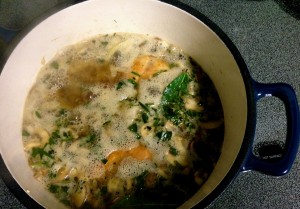
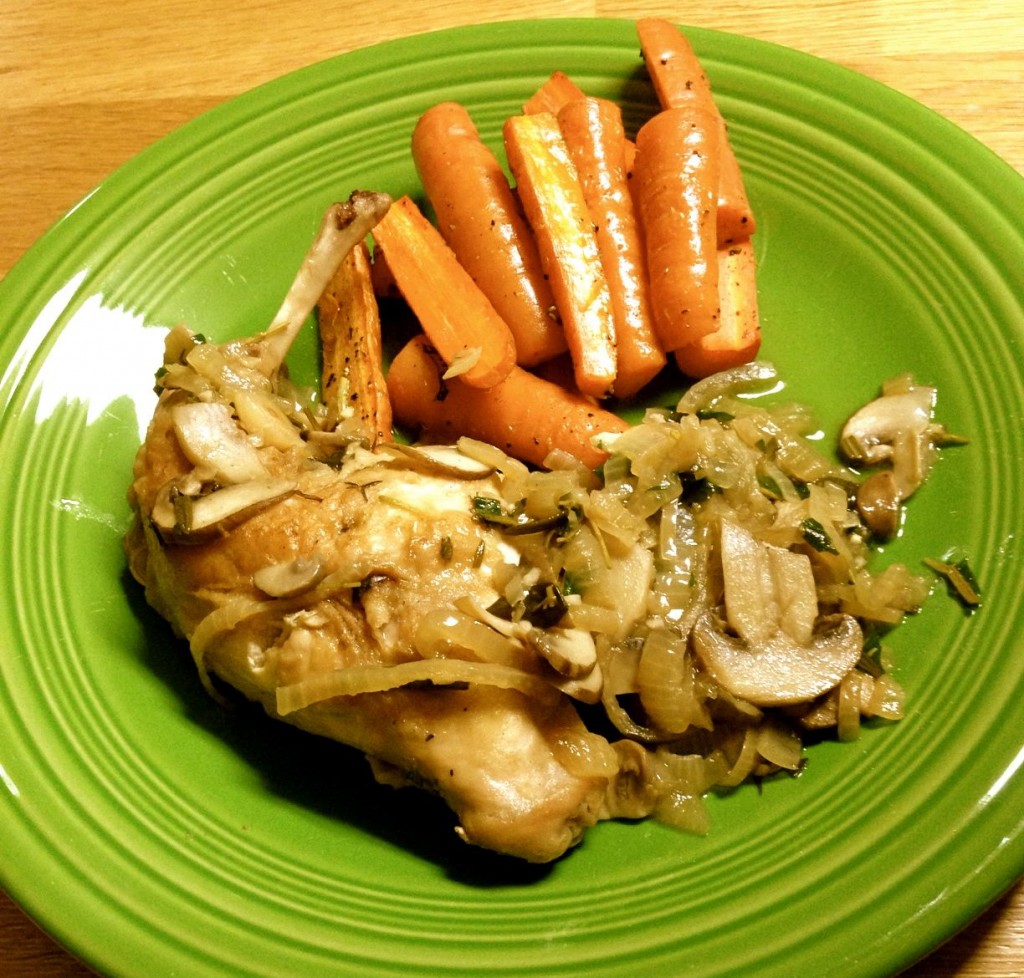
My one failure with this recipe was the sauce. Sauces are the bane of my existence! I can never get them to thicken properly, if at all. In this case, the broth never thickened after I whisked in the butter/flour mixture. I’m not sure where I failed — if there wasn’t enough flour, or if the heat was too high.  I ended up straining out the onions, mushrooms, and herbs and serving them along side the rabbit. Next time a recipe calls for thickening a sauce, I will consult expert sources!

I was surprised at how chicken-like the rabbit tasted. As Tom pointed out in his demonstration, most rabbit dishes could be swapped out with chicken or duck, as all have a similar taste. The rabbit was also quite tender. Braising in the broth for 30 minutes was enough to get it juicy and remove the toughness often associated with game meat. It may also have helped that this particular rabbit meat was farm raised, not truly a game meat in the Teddy tradition. But we can’t all shoot our own, right?

Next time I tackle rabbit, perhaps I’ll get a little more adventurous. But until then, I’ll branch out by exploring my local butcher shop.

Herb and Beer Braised Rabbit

I found this recipe on allrecipes.com. I chose Dry Hopped St. Rogue Red Ale, which was delicious to drink alongside the rabbit … and while cooking the rabbit. The recipe also called for “rabbit meat, cleaned and cut into pieces.” I chose to go with the hind leg quarters, rather than breaking down a whole rabbit (I’ll save that for my next adventure).

1/2 cup all-purpose flour
1/2 teaspoon salt
1/4 teaspoon pepper
2 hind leg quarters of rabbit
3 tablespoons extra-virgin olive oil
1 thinly sliced yellow onion
1 pound thinly sliced mushrooms
3 cloves chopped garlic
1 tablespoon chopped fresh thyme
1 tablespoon chopped fresh basil
1 tablespoon chopped fresh rosemary
2 bay leaves
2 cups amber ale
1 quart chicken stock
3 tablespoons all-purpose flour
2 tablespoons softened butter
1 tablespoon minced fresh parsley for garnish

Combine the 1/2 cup flour, salt, and pepper in a bowl. Coat the rabbit in the flour mixture, turning to get it evenly distributed. Shake off excess flour.

Heat 2 tablespoons of the oil in a Dutch oven over medium-high heat, then sear each side of the rabbit until they pieces are golden and set aside.

Heat the last tablespoon of oil in your dutch oven, add the onions, and cook, stirring, until they’re softened. Stir in the onions and cook until they have softened. Add the mushrooms and garlic. Cook for an about 2 minutes, then add the  herbs.

Add your meat back into the pan, turn the heat up to high, pour in the beer and stock, and bring it to a boil.  When you reach a boil, reduce the heat to medium-low and simmer, with the cover on, until the rabbit is very tender. This should take about a half an hour.

In a separate bowl, combine 3 tablespoons flour and softened butter until smooth. Set aside the rabbit and skim any fat from the broth. Whisk the butter paste into the broth and simmer for an additional 3 to 4 minutes, until thickened. Remove the bay leaves, stir in the parsley. Serve thickened sauce with the braised rabbit.

Tagged with: , , , , , , , , ,
Posted in Dear Diary
photo credit to Aaron Otis Photography 2014


July
Watermelon is the perfect summer food. It hydrates, it cools, it's sweet and juicy. We have some great ideas for your table, including a salad, ceviche cups, popsicles and cocktails. Get ready to beat the heat with us!