A Foodie’s Worst Nightmare! Life Without Smell

5834988590_f2317d0d32_z
Photo credit: William Doran via Flickr

For me, one of the greatest joys in cooking is aroma. The wafting scent of a sauce you’re preparing … the fragrant plume from the slow cooker … the smoky, salivation-inspiring wonder that escapes from the grill when you go to flip things.

But what would happen if your sense of smell were gone?

Meet Dan VanderKolk, an affable giant who lost his sense of smell while engaged in a prank in high school. In an attempt to “hide” evidence – smelling salt capsules he was using as stink bombs – he tried to stash it in his mouth. Unfortunately, the glass capsule broke, cutting his mouth and bathing it in ammonia and alcohol. He was rushed to the hospital, mouth and olfactory senses decimated.

Over the next three months, his mouth and taste buds healed but his olfactory nerves were permanently burned.

We learn taste and texture — and what food is — as toddlers by experimenting with putting things in our mouths. But Dan, at 16, had to relearn to eat after that high school incident; the wires in his brain were crossed. “I lost 12 pounds during the three months,” Dan says. “Everything but broth gave me a gag reflex.”

So, even though his taste buds healed, the disconnect with his olfactory senses caused his brain to misread textures. His brain started reading milk like latex paint and vegetables as sticks.

Even his favorite foods caused problems. “I couldn’t eat mashed potatoes — [it] conjured this mud clay image and I couldn’t do it.” (Lucky for Dan, he did eventually come back around to potatoes.)

Food and eating weren’t the only hurdles. As a teenager just starting to date, Dan became paranoid about his personal scent and started to become OCD about showering, bathing two or three times a day. He’d also douse himself in cologne.

“I would put so much cologne on that no female would want to be in a 200 mile radius of me,” Dan says. “I would put it on until I could smell it — and then it smelled like I showered in it. Only took seven months for someone to tell me I was doing it wrong.”

Today, Dan and his wife, Kamala, are still working through his olfactory obstacles.

For starters, Kamala is challenged with accommodating Dan’s diet along with feeding their children. Impressively, the kids don’t present the challenge you might think — pointing to Dad’s picky eating as a means of avoiding healthy foods like veggies. Their daughter, now in kindergarten, is more inclined to try and eat things because her friends in school are, instead of using “Dad isn’t eating it” as an excuse. And their son has no problems trying new foods … which is sometimes bad news for Dan.

“Our son just smashes these cherry tomatoes and I have to run out of the room. That slimy seed goo in the middle … I can’t get over it.” The memory of that sensory experience, Dan says, is more than he can handle.

Kamala overcomes some of the hurdles with meals that let everyone whip up their own version, like tacos. And now Dan is more involved in cooking — using the grill — so he has a say and knows what is going into the meal — no textural surprises.

On occasion, Dan’s wife will make multiple versions of a dish — either spicing things to a ridiculous level for Dan to get a sense of them, or banishing textural violations like vegetables from Dan’s serving. However, cooking something special for Dan can be an exasperating process, she says. “It’s frustrating where if I put a lot of effort into a meal and he is like, ‘I don’t want that because there are vegetables in it,’ ” Kamala explains. “That’s frustrating, if you put effort into something and the person it’s for rejects it.” It is really disappointing, she adds.

Also, Dan can’t appreciate spicy food. While others enjoy the flavor combined with the heat, his only experience is the pain. Unfortunately for Dan, Kamala likes to add jalapenos to things — to which Dan replies, “Why would you do that — because that just hurts?”

DSC_1714
Photo credit: Patrick Walsh

For Dan, food cravings are almost nonexistent. He eats only to avoid hunger pangs, he says. “I only eat because I hate being hungry.”

But there is one thing he craves sometimes: Papa John’s Meat Lovers Pizza. “I don’t know why,” he says. “I could eat it every meal and never get sick of it.”

So what are the upsides to all this, you ask? Well, Dan can tolerate bad smells that send normal folks running. He smiles broadly when he admits he has no issues diving in when things start to stink. ”If it’s a really bad diaper, I call him,” Kamala offers. “It’s your turn — you do that one,” she’ll tell him.

The only smell Dan does experience is a random one. Sometimes, particularly when he’s coming out of the shower, he can smell popcorn being made.

“I get these phantom popcorn smells,” Dan says. “And I don’t know if what I’m thinking about really does smell like popcorn.” He’ll always call out to see if someone is making popcorn, but, invariably, they’re not.

For my final question, I was about to ask Dan about the impact a cure would have. But before I could, he just shook his head “no.”

“Its hard to tell someone what they are missing with regard to things that smell good. And overwhelmingly, people are complaining about things that smell bad,” he says. “It doesn’t sound like I’m missing much.”

After a particularly malodorous ride home on the metro after this interview, I was thinking that perhaps Dan was on to something. But just a day later, I was preparing a pot roast with coffee, paprika and onions in the slow cooker.

Give up all those delicious aromas? I don’t think so.
Tagged with: , , , , , ,
Posted in Dear Diary

How To Brew Monster Tea: Kombucha

Kombucha01The first time I laid eyes on it I was a little freaked out. Was it an alien life form? Or perhaps a jelly-like creature pulled from the shores of Delaware? And why was it floating in a jar of brown liquid in my best friend’s kitchen?

Needless to say, it’s taken me some time to get over my initial aversions and fears of kombucha. But since then, I’ve embraced it. It’s fizzy, it’s tart and it’s packed full of those helpful probiotics we talked about last month.

So why didn’t I post this a few weeks ago? Why now … in our month of scary?

Have you seen a SCOBY? It’s ALIVE!

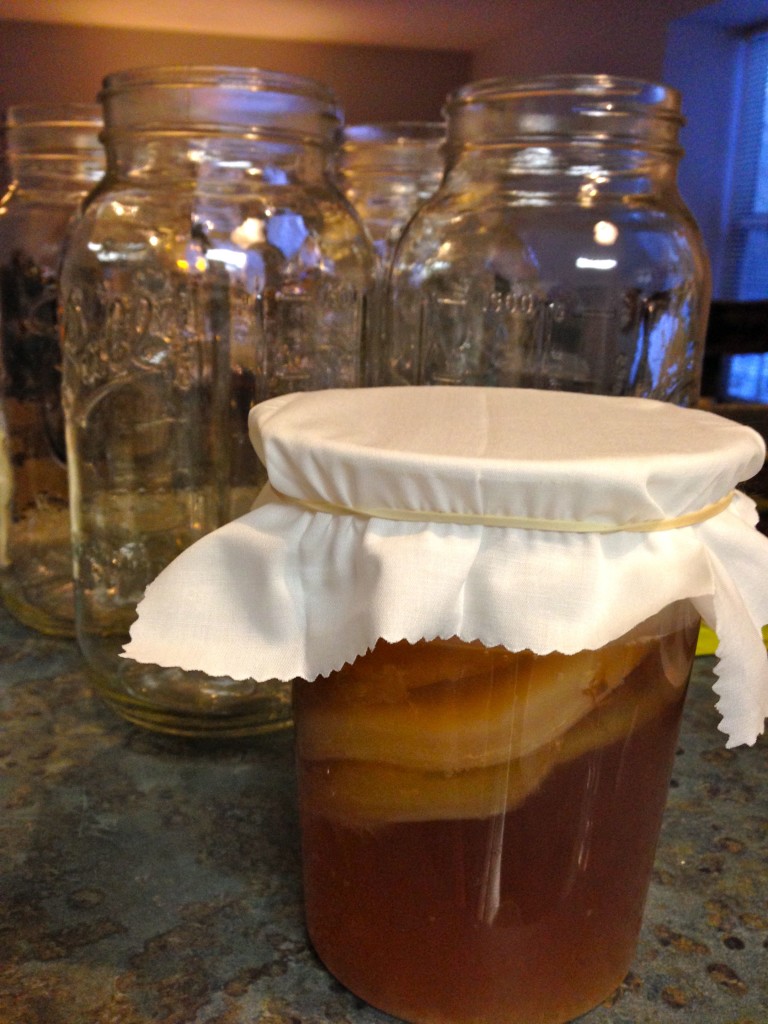
SCOBY is an acronym that stands for Symbiotic Culture of Friendly Bacteria and Yeast. They have a rubbery texture, are off-white in color and are disc-shaped. Like I said … a jelly-like creature! But despite how scary they look, they metabolize the sugar and caffeine in sweet tea to create a beverage filled with probiotics, vitamins, amino acids and enzymes.

Not only does a SCOBY look like something that doesn’t belong in your kitchen, but the process of making kombucha at home can be a bit scary, as well. If something goes wrong or if the SCOBY isn’t healthy, it could make you really sick. If not stored properly the SCOBY can grow mold — this can happen if it’s too cold or not covered properly. In that case, you should immediately throw it out and start over with a fresh one.

Have I scared you enough yet?

I know I was when I got my first SCOBY, from my co-worker Madelyn. She’s become a true convert. Over the last year, she had been experiencing some health issues with no particular diagnosis, other than simply “an autoimmune disorder.” She was exhausted all the time and had soreness and pain all over her body, among various other strange symptoms. She started to look for alternative solutions, such as probiotics, which led to her brewing kombucha at home.

Kombucha10The process of brewing kombucha regularly means that you’ll make new scobies … or monster babies, as I call them. The original SCOBY — the one you start with — is referred to as the “mother.”  I got one of Madelyn’s babies.

And with as much tea as she’s been brewing, I asked her what she’s doing with all those monster babies.

OK … as gross as the whole SCOBY thing is, it can get grosser. Madelyn eats them. She told me that she did a little research, and apparently, there’s no harm in eating the extra ones. There is even a restaurant that uses them in their dishes. After a quick Internet search, I dug up some other culinary uses: SCOBY jerky, SCOBY miso soup or simply SCOBY chopped up and served in a salad. Madelyn even suggested serving some to our puppy, saying it would help strengthen her immune and digestive systems.

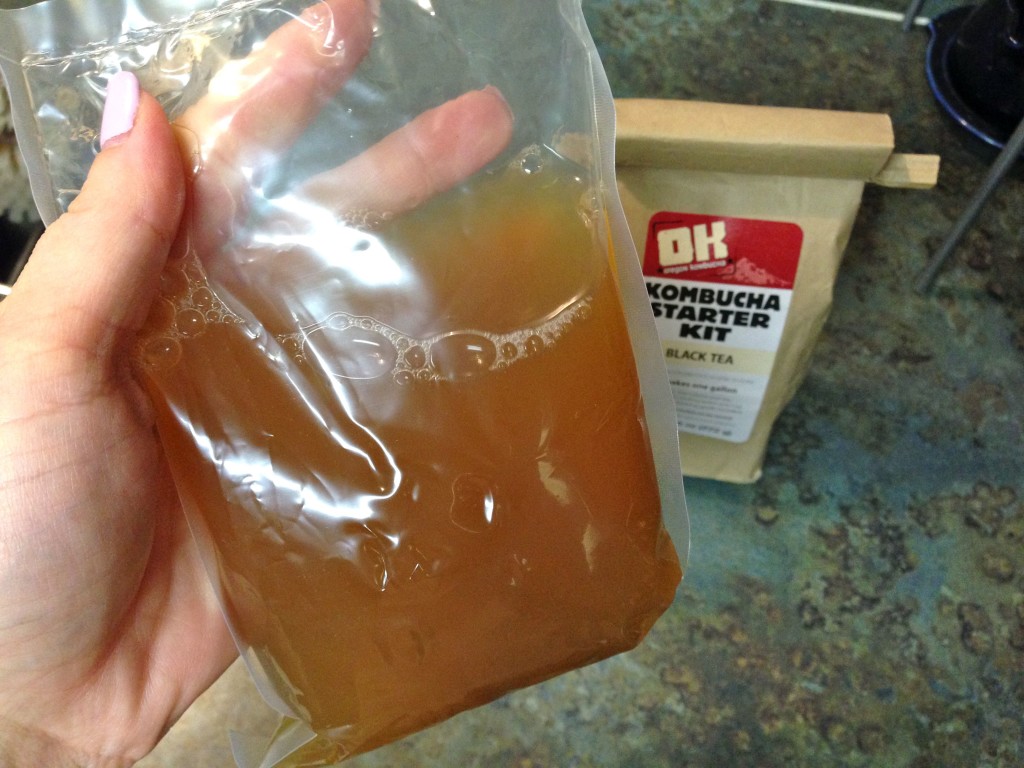
Oregon Kombucha kit with pouch full of small scoby and kombucha starter liquid.

Oregon Kombucha kit with pouch full of small scoby and kombucha starter liquid.

I will admit I have tried none of these. I will probably try to make the jerky, as it seems the least scary of all the options. The tips I have read, by the way, say that the SCOBY should not be cooked. Other than dehydration, it should be eaten raw to preserve the probiotics. It has a tangy, sour taste with a texture like squid … so Madelyn tells me.

If you’re still interested in brewing your own monster tea, there are plenty of resources online. You can even order starter kits that come with a brand new SCOBY. Just go to Amazon and run a quick search. You’ll find companies like Kombucha Brooklyn, Oregon Kombucha  and The Kombucha Company. Most kits will come not only with the SCOBY but also the tea, the sugar and a gallon jar to get things going.

And check out the sites above for further FAQs and tips. While making kombucha is a straightforward process, if you’re new you may have a lot of questions!

And whatever you do … don’t get the scobies wet. Or, wait — is that gremlins?

Monster Tea … Kombucha
If you know someone who brews at home, simply ask them for a spare SCOBY. Just make sure they give you some of the kombucha liquid as you’ll need that to start your batch. It’s simple to recreate the kits on your own. My instructions are for one gallon, but you can easily adjust for a half-gallon, just cut the amounts in half.

Ingredients
1 gallon boiling water
1 cup sugar, organic or regular
10 to 12 tea bags, regular black, green or white
1 cup liquid kombucha
1 live SCOBY

Equipment
Long handled metal or plastic spoon, not wooden
Clean, 1-gallon glass container, to brew kombucha
Clean, light weight cloth cover, to cover the brew container (This could be a kitchen towel, paper towel, cloth napkin or cut up t-shirt. Anything that will cover the container, but allow air to pass through.)
Large rubber band or string to keep the cloth cover tight
Clean bottles with tight-fitting lids to store your finished brew
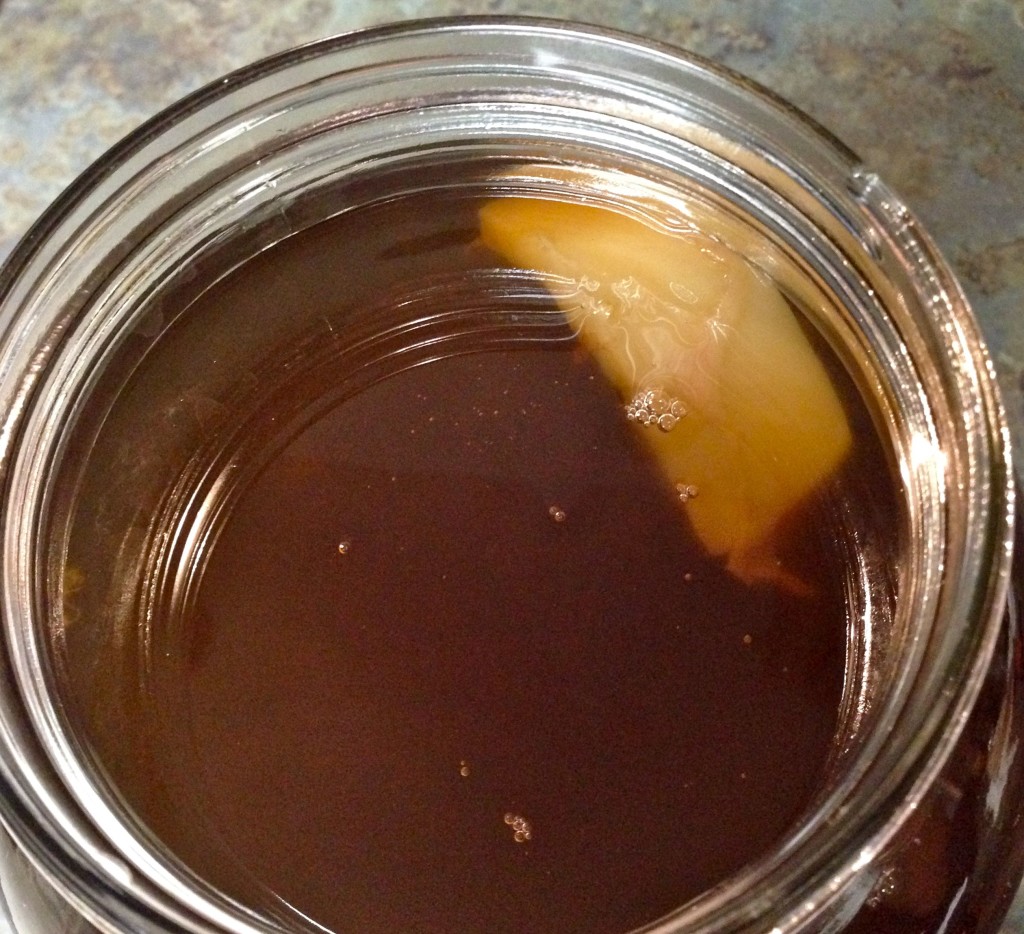
Kombucha04
Brew the tea. Boil 1 gallon of water in a large pot. Remove from heat. Add the tea bags and stir. Black tea will complete brewing in 4 minutes, while green or white will brew in 2 to 3 minutes. Add 1 cup of sugar, stirring until dissolved. Pour the hot tea into the brew container. Allow the tea to cool to room temperature. This can take several hours, but it’s extremely important to the brewing process — if you add your SCOBY to the hot tea, it will die. I tend to brew my tea at night, allowing it too cool while I sleep.

Add the SCOBY. After allowing the tea to cool completely to room temperature, add 1 cup starter kombucha liquid. If ordered online, the SCOBY should be floating in this liquid. This will help it acclimate to the new environment. Add the SCOBY and cover the container, securing with the rubber band or string.
Kombucha06
Wait. Kombucha can take anywhere from 7 to 30 days to brew, depending on your taste and the environment where it is brewed. The fastest temperature it grows in is 80 to 85 degrees. This is nearly impossible to attain in my kitchen, so my kombucha tends to take a little longer. After day 7, begin tasting and taste again every few days until it hits your desired flavor. Essentially, it should be tangy and not taste like tea. The longer you brew, the tangier your brew.

Bottle. Transfer the finished kombucha to your bottles, ensuring the lids fit nice and tight. If you want a carbonated, fizzy kombucha, allow the bottles to sit at room temperature for 24 to 48 hours before refrigerating. Refrigeration will stop the fermentation process. The bottles can store for months.

Brew again or store. You can then start a brand new batch of kombucha, following the steps above. To store the SCOBY until you begin a new batch, either leave it floating in a cup of the liquid kombucha covered at room temperature or, for longer-term storage, use a tight fitting lid and store in the refrigerator.

Tagged with: , , , , , , , ,
Posted in Dear Diary

Food Poisoning, Food Allergies & Food Additives, Oh My!

The featured image used on the previous page is courtesy of Kerry Lee Smith via Flickr.

corn
Photo credit: James Henley via Flickr

Food is a treacherous thing.

I know I speak sacrilege in saying such things, but give me a moment to make my case.

Food kills. Not in the Mama Cass and a ham sandwich sort of way (which isn’t true, anyway), but in many others. Take food in just about any foreign country, for example.

It is not choclo‘s fault that approximately 12 hours after savoring each delicious corn kernel purchased from a not-so-legit-looking street vendor that I wound up on the bathroom floor of my rental house in Peru’s Sacred Valley.

Wishing. I. Would. Die.

The same thing happened to me in India. I love chole, but there, the place where all good chole comes from, it did not love me back. And just last year, after a dining experience in the Ubud region of Bali, both my husband and I regretted thinking it would be okay to eat at a place with the word “dirty” in the restaurant name. Yes, really.

Food can make you sick. In fact, earlier this year, 216 attendees of a food safety summit in Baltimore, Md., got sick from contaminated food (chicken, to be precise). Just this week: a hummus recall in Canada, a beef trimmings recall and even a pet food recall. Salmonella, E. coli and listeria … oh, my!

Then there are food allergies. The journal Pediatrics just published

fast food
Photo credit: Scott Ableman via Flickr

a study that suggests, in the U.S., about six million kids experience allergic reactions to food. That’s half of the 12 million people in the country with food allergies, leading anyone with enough healthy brain cells to conclude that the number is on the rise. Peanuts, seafood and milk are only the tip of the iceberg when it comes to foods that can cause anaphylaxis — “a severe, whole-body allergic reaction to a chemical that has become an allergen”, which can potentially be lethal. For those with an allergy like this, one bite can literally be a death sentence.

And then we have the food that we put in our bodies knowing they are probably toxic … or just plain nasty. Like the hamburgers in the school cafeteria, which NPR reports has 26 different (and mostly unpronounceable) ingredients. Poor kids, right? Well, stop reading this now if you ever want to eat fast food again. Subway egg sandwiches contain a “premium egg blend,” which includes glycerine and silicone. As The Huffington Post puts it, soap and Silly Putty. And don’t try to be healthy and order a side salad … that same article claims, “many places dust their salads with propylene glycol to keep the leaves crisp.” Don’t get me started on soda.

Gross. I repeat:  Food is a treacherous thing.

donutAs part of Project Detox (a six month adventure to getting healthier — and you can join us!), my husband and I have decided to try Whole30. The plan is “designed to change your life in 30 days.”  by changing the way you think about food, your tastes and cravings. It’s quite similar to paleo, but focuses more on resetting the body to eliminate cravings and identifying food sensitivities. If you decide to change your eating style when you finish 30 days on the program, do so slowly and one at a time to see how you feel. If symptoms resume, you may want to consider eliminating that food from your diet. You can find out what you eat on the plan HERE, get recipes HERE, and find out if it could work for you HERE. I’ll be reporting on my progress in Project Detox.

I’m approaching a phase of Whole30 too appropriate for the horror show that will be our posts this October, including other Eater’s food debacles, slimy scobies, the weirdest things our Eaters have ever eaten, a magic berry that makes sour pickles taste like candy … and the story of a man with no taste buds. The phase is called Kill All The Things.

Food is a treacherous thing.

Tagged with: , , , , , , , , , , , , , , , ,
Posted in Dear Diary
photo credit to Aaron Otis Photography 2014


July
Watermelon is the perfect summer food. It hydrates, it cools, it's sweet and juicy. We have some great ideas for your table, including a salad, ceviche cups, popsicles and cocktails. Get ready to beat the heat with us!